Culture
Ball de Bastons: Understanding Catalonia's Stick Dance
Find a public ball de bastons performance, follow its music and formations, respect the working space and know when joining is genuinely invited.
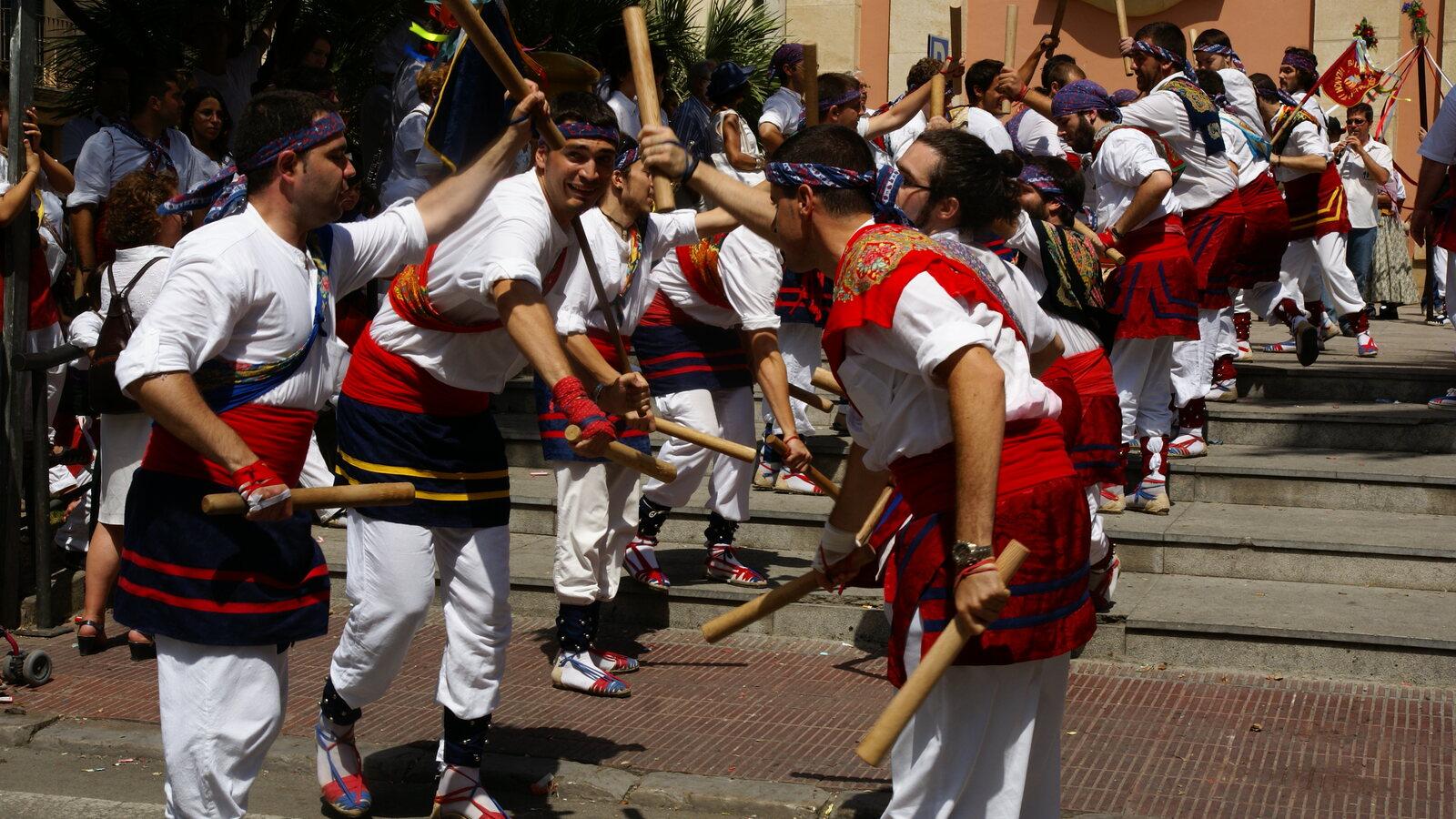
The wooden strikes in ball de bastons are rehearsed contacts, not an invitation to imitate a fight at the edge of the crowd. Choose a performance published by a named colla bastonera, town hall or festival programme, then watch from the public perimeter. Join only when the event explicitly says taller—workshop—or a dancer directs you into a teaching session with suitable sticks.
That boundary makes the dance easier to appreciate. Instead of wondering when spectators can enter, listen for a repeated musical phrase and watch how each pair changes partners, direction or height without breaking the beat. The apparent clash becomes a precise exchange among music, footwork and wood.
A colla turns impact into choreography
The dance is performed by a colla, an organised group whose dancers may be called bastoners and bastoneres. Most carry a wooden stick in each hand. They strike another dancer’s sticks, their own sticks or occasionally the ground while stepping through a memorised pattern. A flag bearer may carry one stick and the group’s standard instead of a pair.
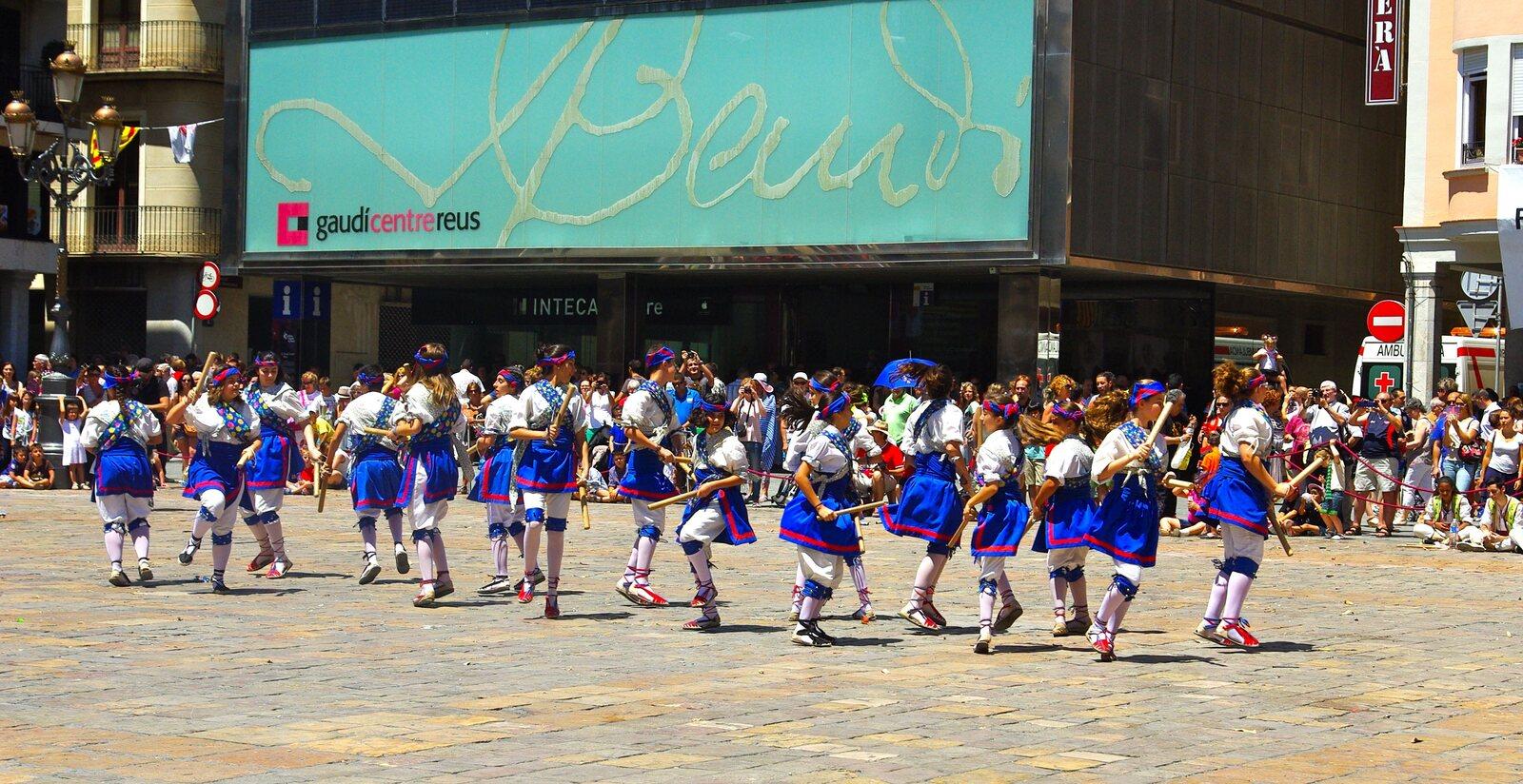
Rows facing each other are common, as are smaller squares, crossings and rotating formations. One dancer delivers a contact while the partner receives it in the agreed position; the roles and hands can change inside the sequence. The crack sounds forceful because the contact is meant to be clean and rhythmically audible. It is not evidence that the dancers are improvising aggression.
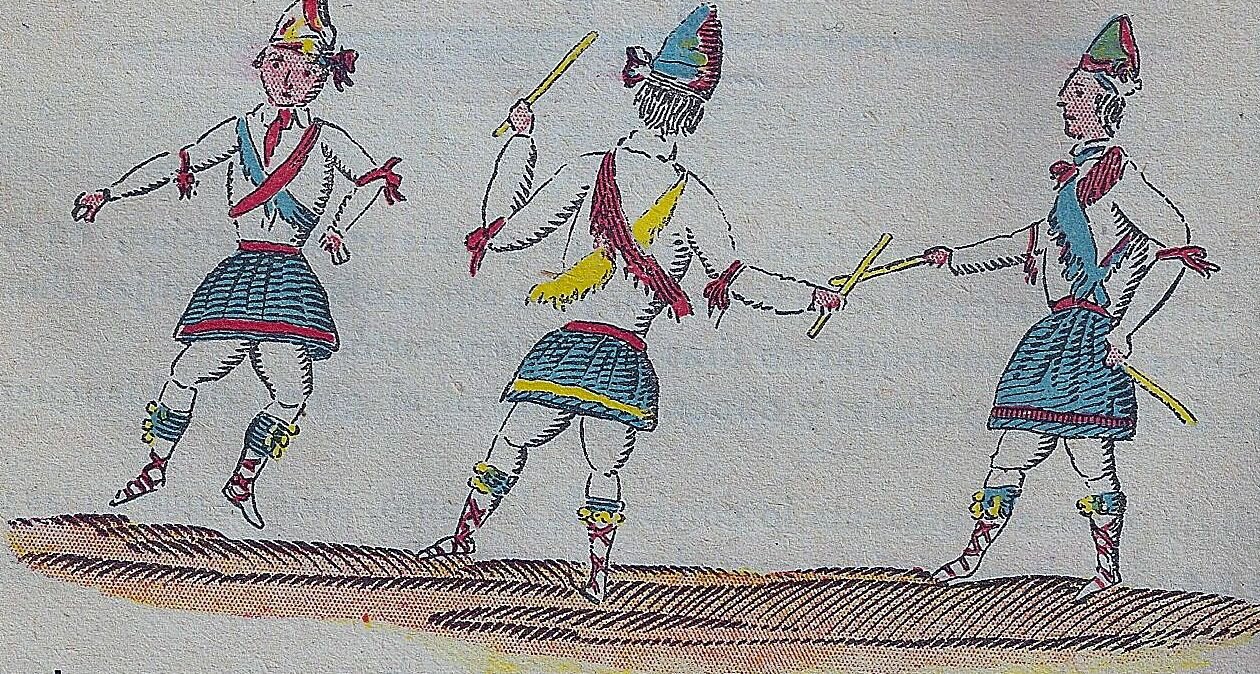
Descriptions sometimes reduce ball de bastons to a mock combat or claim a single ancient origin. The visual resemblance is obvious, but origin stories are less useful to a first-time spectator than the documented local traditions in front of them. The Generalitat’s heritage catalogue records Tarragona’s version in 1633, Solsona’s in 1680 and L’Arboç’s in 1770. Those dates establish long local histories; they do not make every present-day colla a branch of one unchanged choreography.
Hear the melody before counting the blows
The sticks add percussion, but the melody controls the phrase. Listen once without trying to follow every hand. A short tune may repeat while the dancers complete several figures. At a cadence, the contacts may accelerate, stop together or open space for a turn. Foot bells or picarols, when worn, add another layer to each step.
Do not expect one compulsory instrument. A gralla’s bright reed sound accompanies many groups; others use a flabiol or another flute, a drum, a small ensemble or recorded accompaniment. The Tarragona heritage description specifies flute for its Santa Tecla ball and includes a macer, carrying a large mace, and a comic devil with a pitchfork. Those characters belong to Tarragona’s version, not to a universal cast.
Names for movements vary too. Sotacama commonly describes a strike made beneath a raised leg. In some regional vocabularies, rebatre is a rapid three-contact ending to a musical phrase. Recognising the effect is enough; do not correct a dancer’s term from a glossary written for another comarca.
L'Arboç shows why costume is local information
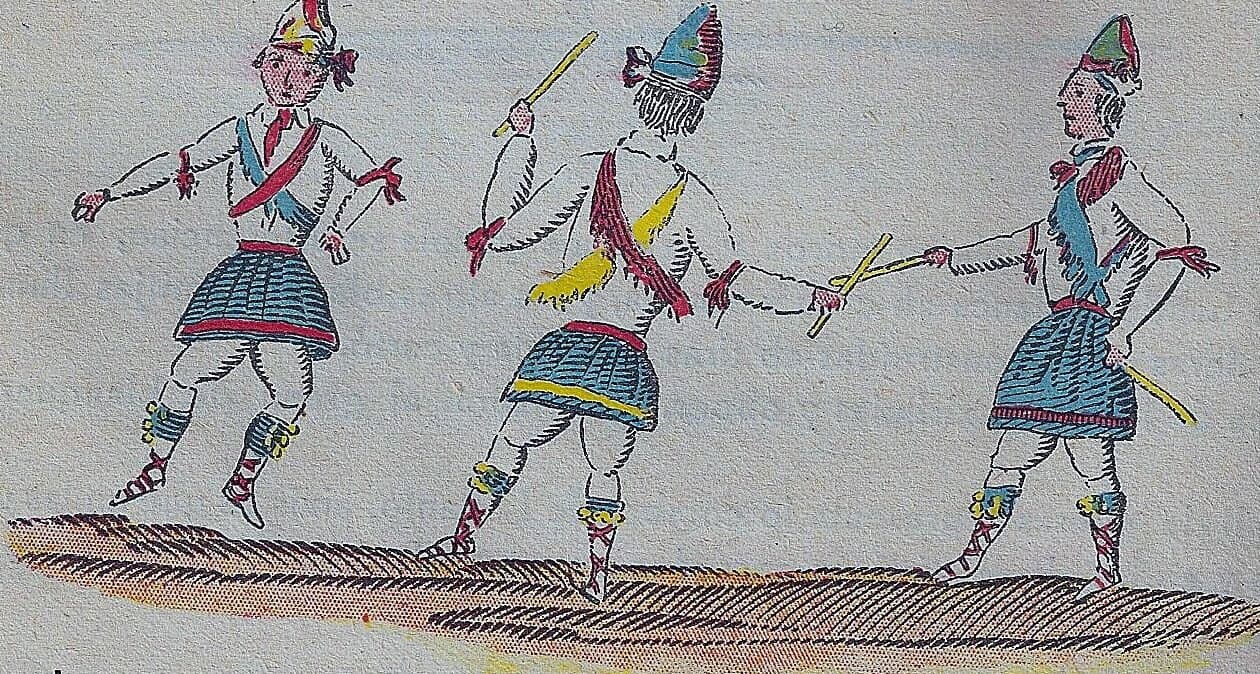
White trousers, coloured sashes, short overskirts, crossed scarves, headwear, espadrilles and bell-covered leg pieces recur, but their colours and combinations identify particular groups. Costume is not a generic Catalan uniform available for spectators to copy.
The official L’Arboç ball de bastons record documents unusually exact distinctions: navy and red are arranged differently in the men’s and women’s outfits; its oak sticks have specified lengths and weights; and the repertoire includes orally transmitted melodies alongside newer compositions. That level of detail belongs to L’Arboç’s continuity.
Solsona offers another contrast. Its heritage entry describes an all-child group whose dancers serve as pages accompanying the image of the Mare de Déu during processional routes. The four-part choreography and ceremonial function cannot be treated as interchangeable with a contemporary adult colla appearing on a concert stage.
Age and gender are therefore observations, not rules to infer. Some established groups preserve a defined cast for a particular ritual; many contemporary colles are mixed and include several age groups. Ask about the named colla if that history matters rather than declaring what “the tradition” allows from one photograph.
Find the named set inside the festa major programme
Ball de bastons often appears within a festa major, a seguici of ceremonial and popular elements, or a cercavila moving through streets. It may also be a static ballada in a square, a gathering of several colles or a workshop. Those formats create different viewing decisions.
Start with the Coordinadora de Ball de Bastons de Catalunya to identify active colles, news and gatherings. Then open the current page of the group or host municipality. Search the dated programme for ball de bastons, bastonada, trobada bastonera, seguici or cercavila. Confirm the year, start time, first location and whether the entry describes a route or a fixed set.
An annual Trobada Nacional de Bastoners brings groups together, but the host and practical layout change. A search result from an earlier edition cannot tell you where this year’s public sets occur. Likewise, “Festa Major, 18:00” may be the departure of a procession rather than a stage time at the main square.
Treat price as part of that same programme check. When a municipal schedule presents the dance on a public street or square without a ticket link, budget €0 for the performance. A festival enclosure, reserved seat or advertised workshop may have its own charge and registration rule; never infer that the public performance price also covers a teaching session.
If your aim is to understand one choreography, a fixed square performance is easier than chasing a moving parade. If your aim is to see how the dance occupies a town, choose the seguici and identify one broad corner where the route slows without blocking doorways or residents.
Read one complete dance instead of filming ten seconds
Stand where you can see feet as well as sticks. The most useful sequence to follow is not the loudest strike but the transition around it:
- the musicians establish or repeat the melody;
- dancers settle into rows, pairs or a compact square;
- a contact pattern repeats at high, middle or low level;
- footwork moves each person toward a new partner or position;
- a cadence closes the figure before the next pattern begins.
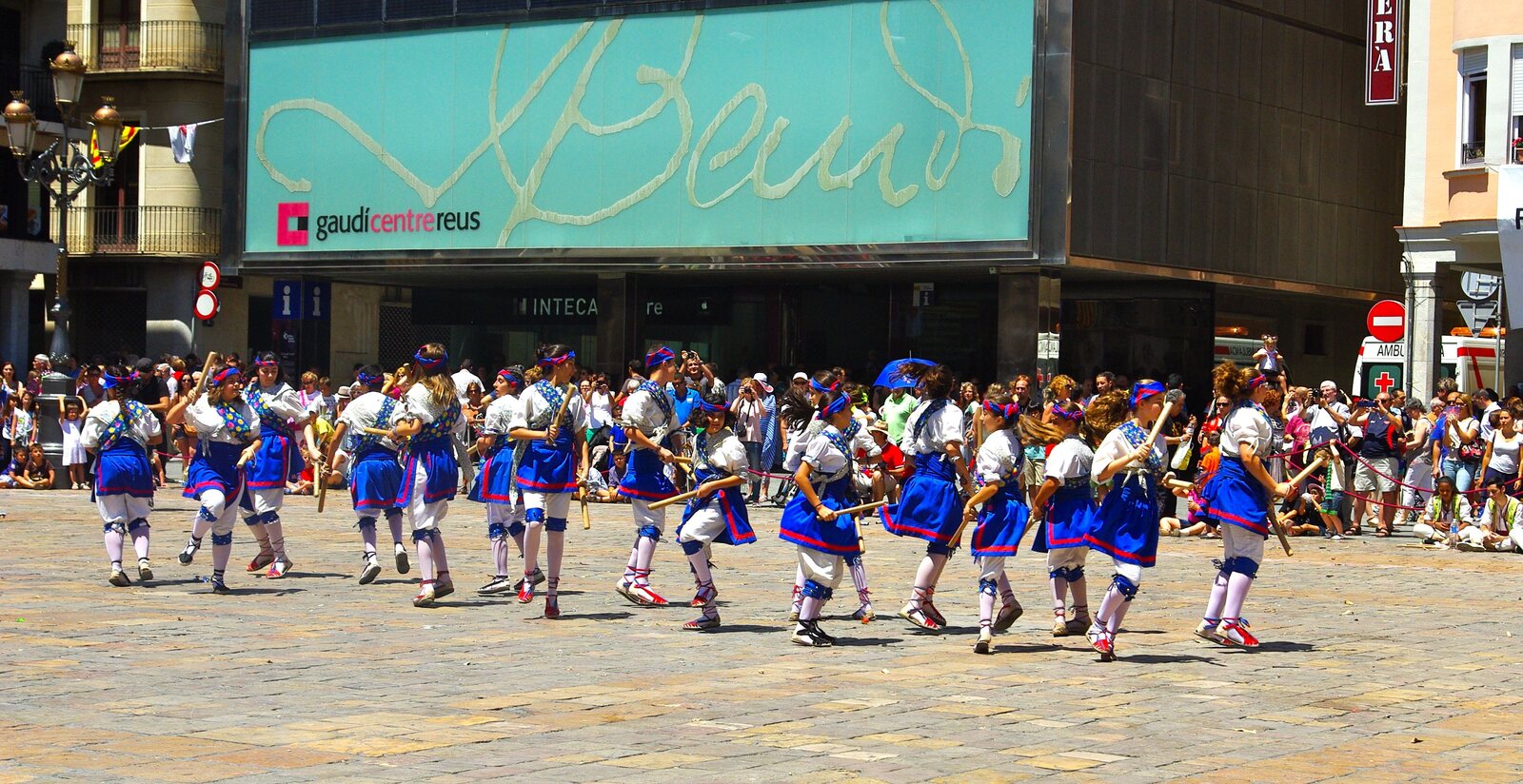
In a large Reus formation, several pairs can perform the same exchange at once while the line bends across the square. In a narrow street, a group may compress the same visual logic and advance between repeats. A static photograph captures the raised sticks; watching the partner change reveals the dance.
Local cheers, a shouted cue or a final flourish may release the tension. Applaud when the set resolves or follow the surrounding audience. Keeping a phone lowered for one entire piece gives you the information a short clip usually misses: how the sound, step and formation return to their starting logic.
The empty space around the sticks is working space
A raised stick can travel behind or beside the dancer before contact. Leave the whole marked or informally cleared area to the colla. Do not stand in a gap because it looks empty at that instant, crouch between pairs for a low photograph or let a child approach a dancer from behind.
During a cercavila, keep the musicians, dancers and flag together. Spectators sometimes interpret the few metres between elements as a crossing point, only to meet the next backward step or turn. Wait for a steward’s signal or for the entire group to pass. Keep dogs outside the first row; sudden stick noise and tightly moving feet are a poor place for a lead to cross.
Photograph from the audience side without flash. A wide frame explains the formation better than pushing close to one strike, and a short clip should not require walking alongside the colla through a crowded route. Do not handle a flag, costume piece or spare stick placed near the musicians. It is working equipment, not a festival prop.
Rain can move or cancel a set because wet stone changes footwork and grip. If the published place is empty, check the organiser’s same-day notice or ask an information point where the ballada has moved. Do not follow costumed dancers into a preparation room or private assembly courtyard in search of the performance.
A workshop is the proper route from watching to striking
Ball de bastons is not an open circle in the way some public sardana sessions can be. The sticks have weight, partners expect contacts at rehearsed heights and hands occupy the space that a beginner is most likely to misjudge. Copying a low strike beside the formation risks the dancers as well as the spectator.
An advertised taller de ball de bastons changes that relationship. A workshop documented by the CPNL, for example, was organised as a taught cultural and language activity rather than spontaneous entry into a performance. The current organiser should state the age, registration and equipment arrangements for its own session.
At a workshop, use the sticks provided, hold the spacing set by the instructor and practise the contact slowly before adding footwork. Do not bring trekking poles or ask a performer to teach a flourish between scheduled dances. If no teaching session is offered, ask the colla where and when beginners can make contact; rehearsal membership is a relationship with the group, not a souvenir activity acquired on demand.
The respectful first experience ends at the audience edge. Find the right dated programme, listen for the repeating phrase, watch one pattern travel through the formation and let the final strike land without your camera—or your borrowed stick—inside it.
Related guides
- Three Kings in Catalonia: Parade, Gifts and Visitor Etiquette
Watch a Catalan Three Kings cavalcade with context, understand the pages and letters, and keep the public parade separate from private family gifts.
- Revetlla de Sant Joan: Fireworks, Bonfires and Etiquette
Understand Catalonia's 23 June midsummer night, where public events end and private celebrations begin, and how to handle fireworks safely.
- Catalan Living Nativity Scenes: How to Visit a Pessebre Vivent
Choose a Catalan living nativity by format and terrain, then handle tickets, winter conditions, religious context and photography respectfully.
Are you in the know?
Receive new articles, local updates, and occasional offers from selected partners. We never share your email address. Unsubscribe at any time.
By subscribing you agree to our privacy policy.